


The views expressed by the author are their own and do not represent the views of Energy Workforce & Technology Council.
By Dr. (Hon) Amanpreet (Aman) Kaur, Chief AI and Technology Officer, Equipt.ai
Aman is Chief AI and Technology Officer at Equipt.ai, where she leads product architecture, AI systems design, and platform evolution. With deep expertise in building scalable enterprise systems and applying AI to real-world operations, she focuses on simplifying complex workflows and enabling seamless execution across asset-intensive environments.
Turning Signals into Intelligence That Drove Action
When Artemis II lifted off, it was not because dashboards looked good.
It was because thousands of systems, decisions, and actions aligned in real time.
No one in mission control waited for a report to explain what had already happened. Every signal mattered. Every delay compounded. Every action had to happen in context and at the right moment. There was no separation between knowing and doing.
That was what execution looked like when failure was not an option.
Now compare that to how most industrial operations still run today.
X Works Until Y. That’s Where It Breaks.
Data is not the bottleneck. Execution is.
Traditional software performs well when workflows are predictable, and timing is flexible. But when operations require real-time coordination across systems, teams, and assets, most platforms begin to break down.
The issue is not the absence of data. The issue is the gap between information and action.
A field ticket is created. A technician is dispatched. An asset is marked “available” in one system, but not in another. The data exists. The workflow does not.
What follows is familiar: calls, follow-ups, manual checks, delays, and avoidable friction.
The system did not fail because it lacked information. It failed because it could not turn information into timely, coordinated action.
As McKinsey has shown, improved coordination alone can increase the productivity of high-skill workers by 20 to 25 percent. That is a powerful reminder that significant value is often lost not in planning, but in execution.
The Illusion of Control
For years, enterprise systems have been designed around visibility. Dashboards, reports, and alerts have been treated as the foundation of operational control.
But visibility is not the same as execution.
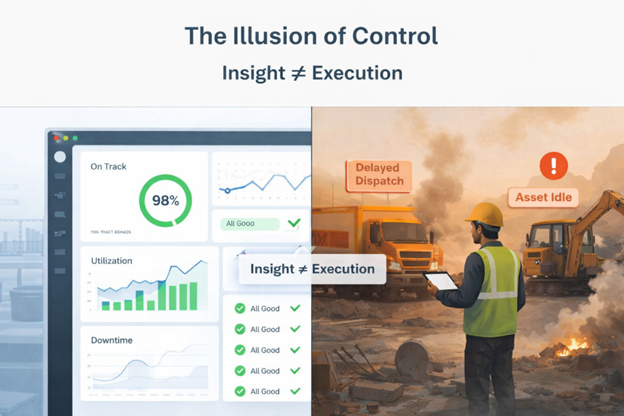
This reality can be simplified as:
Value = Data × Context × Action
Most systems today optimize for data and, to some extent, context. But when action is delayed or disconnected, value collapses.
By the time a delay appears on a dashboard, the damage is already underway. Utilization reports show inefficiencies after the opportunity to correct them has passed. Performance reviews often analyze execution that is no longer actionable.
Organizations end up optimizing for hindsight in environments that demand real-time coordination.
Where Coordination Breaks Down
The limitations of traditional systems are not theoretical. They show up every day in ordinary workflows.
Consider a simple equipment deployment.
| What should happen | What actually happens |
| • Asset is ready • Certification is valid • Crew is aligned • Dispatch is confirmed | • Asset shows as available, but inspection is incomplete • Certification lives in another system • Crew changes happen last minute • Dispatch gets delayed |
Not because people failed. Not because systems do not exist. But because systems do not execute together.
They inform. They do not act.
That is the real fault line in modern operations.
From Hindsight to Real-Time Execution
For decades, enterprise software was built to record what happened. That model worked when operations moved slower and complexity was easier to contain.
But operations today are continuous, distributed, and time-sensitive. They do not need better records alone. They need systems that can respond as work unfolds.
The shift is straightforward: software can no longer remain a passive observer. It must become an active participant in execution.
When equipment is being deployed, readiness, certification, crew alignment, and dispatch cannot exist as isolated checkpoints. They must remain synchronized in real time. If even one part lags, the workflow begins to fracture.
This is the new requirement for operational software: not simply to capture signals, but to translate signals into coordinated action.
Systems of record tell you what happened. Systems of execution ensure what should happen actually does.
Why This Shift Is No Longer Optional
Operations are not becoming simpler. They are becoming more interconnected, more distributed, and more time-sensitive.
Organizations are managing more assets, more dependencies, more decisions, and less room for delay.
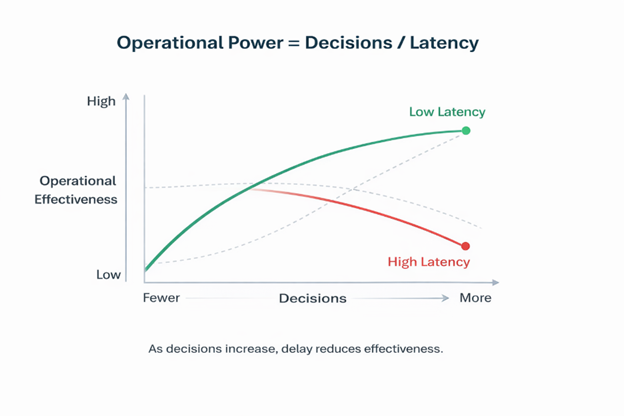
This can be expressed simply:
Operational Power = Decisions / Latency
As the number of decisions increases, every delay reduces operational effectiveness. In this environment, the cost of latency is not linear. It compounds.
A small misalignment early in a workflow can lead to missed revenue, underutilized assets, delayed service, margin erosion, and reactive firefighting downstream.
At the same time, infrastructure is becoming more intelligent and more autonomous, while execution on the ground often remains fragmented and manual.
That mismatch is where many modern operational inefficiencies begin.
Bringing Software Platforms to Life
A digital operational platform should not be defined by the data it stores. It should be defined by the actions it enables.
A platform becomes truly valuable when it can sense what is happening, interpret what it means in context, and respond in real time. That is what separates static software from systems that actively support the business.
How we think about the future of enterprise software: not as systems built to display work, but as systems built to move work.
We cannot build software to simply store and surface information. Instead, we must build software that brings operations to life by enabling the ecosystem around assets, services, inventory, and teams to translate signals into action.
That is the shift from observational software to execution intelligence.
What Wins in Modern Operations
Software does not fail because intelligence is missing. It fails when intelligence remains disconnected from execution.
The platforms that will lead are not the ones that merely describe what happened. They are the ones that help ensure the right things happen as operations unfold.
In the end, value is not created by insight alone.
Value is created when what should happen consistently does.
Energy Workforce partner Equipt.ai offers insights into the realities of energy work.
