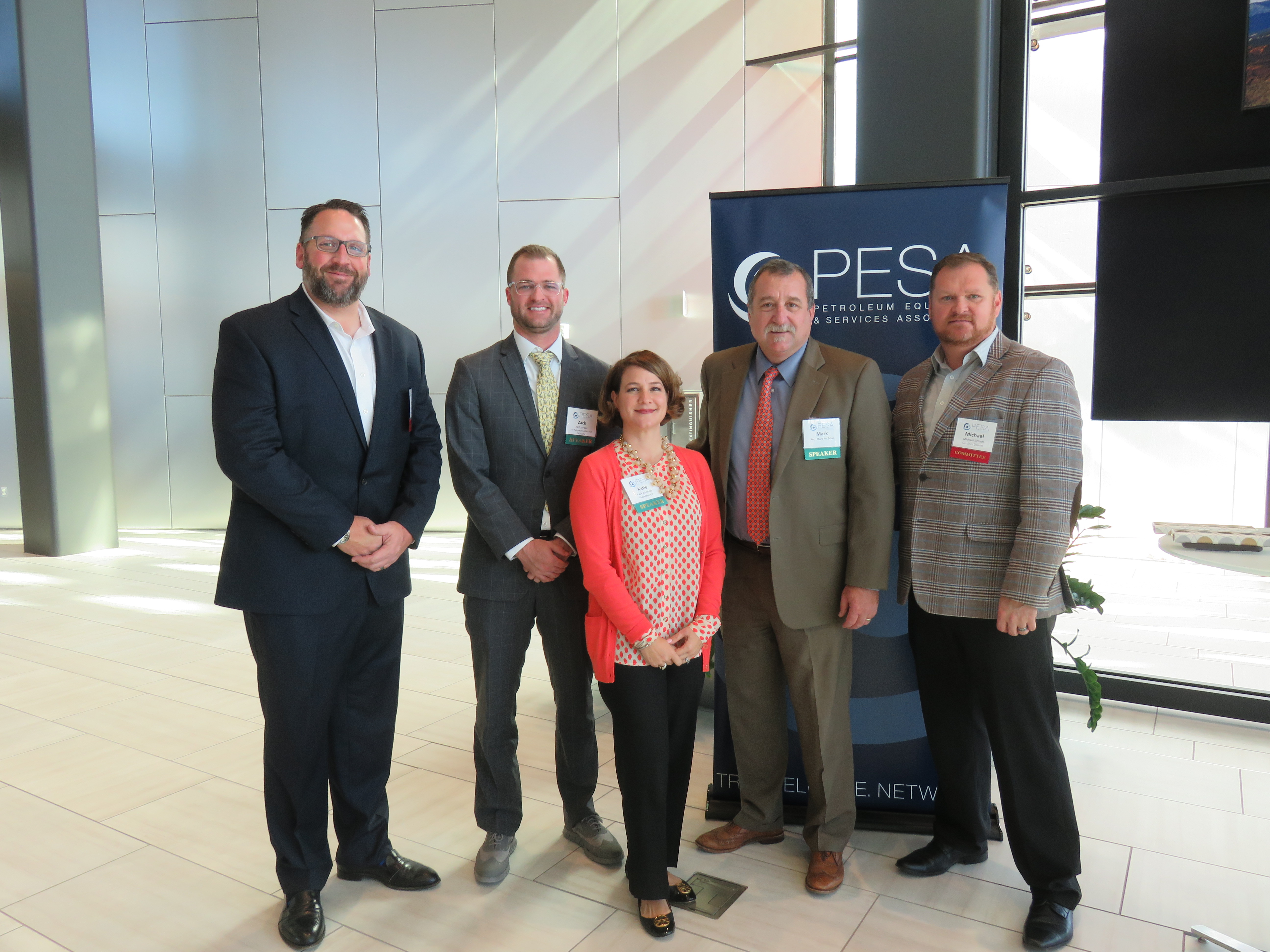
 On November 19, PESA held a Mid-Continent Regional District Meeting at Baker Hughes’ Innovation Center of North America in Oklahoma City, giving insights into current market conditions in Oklahoma, as well as upcoming issues facing the industry in the Sooner State.
The meeting featured panelists Katie Altshuler, Government and Community Affairs Lead, Marathon Oil; Zachary Lee, Vice President of Government Affairs, The Petroleum Alliance of Oklahoma; and State Rep. Mark McBride (OK-53).
Kristin Hincke, Senior Director Government Affairs, PESA, kicked off the meeting and Michael Sirmon, PESA Mid-Con Steering Committee Co-Chair and Director of Operations, Gardner Denver, gave opening remarks and introduced the panel while Carter Robinson, PESA Mid-Con Steering Committee Co-Chair and General Manager, Well Testing, Oil States Energy Services, moderated the discussion.
The first question focused on the 2019 session, and Lee forecasted how several pieces of legislation passed last year will affect the upcoming 2020 session. He also explained that Oklahoma’s legislature runs on a two-year cycle so many of the bills from 2019 that were not passed will be carried over in 2020.
Alshuler commented that the industry is dealing with a patchwork of rules affecting regulations in Oklahoma, such as setbacks. Industry leaders are working with the Municipal League to reduce this regulatory burden.
McBride said he sees the biggest unknown facing the legislature in 2020 is the uncertainty regarding the 47 new members of the legislature. Not knowing what bills these members will run is a challenge for longer serving members. He emphasized that no legislation should be pushed that does not benefit the industry.
 According to Lee, all eyes are on the Supreme Court as the case of Sharp v. Murphy is decided. This case stems from the appeal of the murder conviction of Patrick Murphy, a member of the Muscogee (Creek) Nation, whose crime occurred on the Creek reservation, and his appeal argues federal tribal courts should have had jurisdiction. Murphy alleges that the conviction should be overturned due to lack of jurisdiction. The Court’s decision could apply to other tribes in Oklahoma – the Chickasaw, Choctaw, Cherokee and Seminole. Depending on how the case is ultimately decided, the outcome could dramatically affect mineral rights and production in the eastern part of the state.
The panel discussed the declining rig count in Oklahoma, but Altshuler cautioned attendees that this count is not as relevant as it used to be. She pointed to innovations in production making processes more efficient while maintaining production levels. In her opinion, low commodity prices continue to be the biggest obstacle facing the industry in the state.
McBride, who serves as Chair of the Appropriations for the Budget Education Committee, is concerned about low oil prices as they affect every aspect of state funding, including education. He also cautioned attendees that the stress on the state’s budget could cause lawmakers to push to increase the state’s gross production tax again. He anticipates that if commodity prices remain low, there will be a push to increase the tax to seven or perhaps 10 percent on new wells.
All three panelists encouraged audience members to speak out about the industry at every opportunity and not just at the state capitol. Building relationships within their communities when times are good is vital to maintaining support when times are tough.
CORPORATE SPONSORS